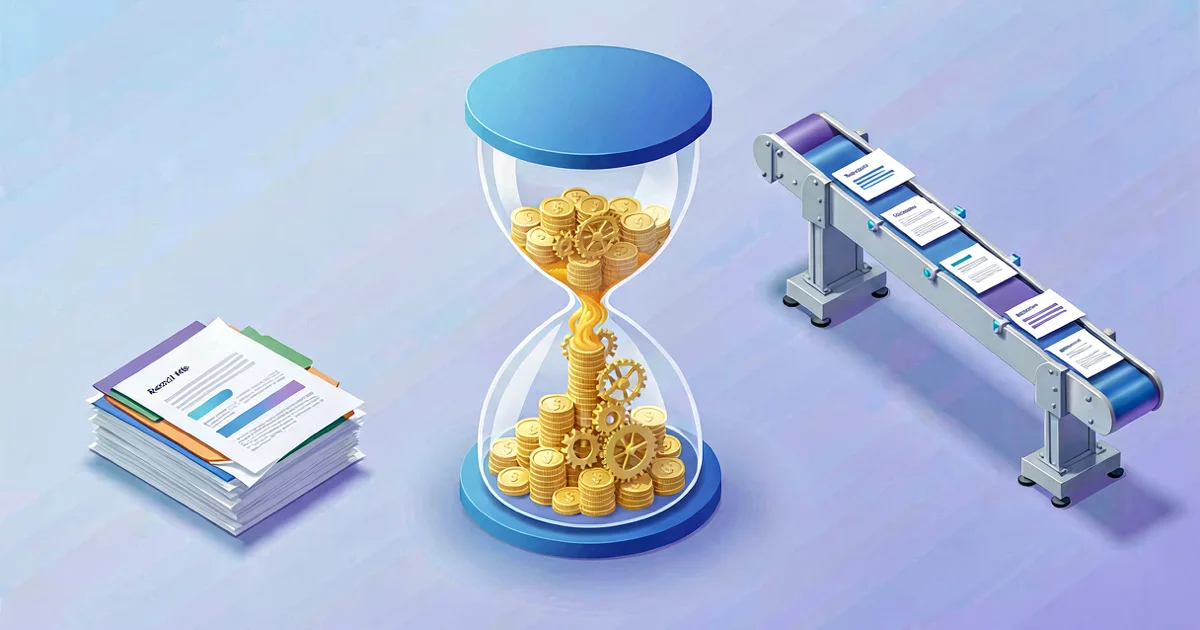
Manual work feels free. Nobody invoices for the twenty minutes spent copying numbers between two systems, so it never shows up as a cost — it just disappears into the day. That’s exactly why it’s so dangerous: the most expensive processes in most small businesses are the ones nobody has ever added up.
The good news is that the cost is hiding in plain sight. Once you know where to look, you can put a number on doing something by hand — and that number is the single most useful input for deciding what to automate first. This is how we help clients find it, without turning it into a three-month consulting project.
The four costs nobody counts
When people think about the cost of a manual task, they think about the time it takes. That’s real, but it’s usually the smallest of four costs — and the other three are where the money quietly leaks.
Time. The obvious one. How long the task takes, multiplied by how often it runs, multiplied by the loaded cost of whoever does it (salary plus overhead, not gross salary). Ten minutes a day doesn’t feel like anything; over a year it’s roughly a full working week.
Errors and rework. Humans doing repetitive work make mistakes — a transposed figure, a skipped step, the wrong file attached. Each error has a cleanup cost, and sometimes a customer cost. A 3–5% error rate on a high-volume task is often more expensive than the task itself.
Delay. Manual work happens in batches, when someone gets to it. An invoice that could be approved in minutes waits until Friday. A lead that could be answered in two minutes is answered in two days — by which point the prospect has gone elsewhere. Delay rarely shows on a spreadsheet, but it shows in lost deals.
Key-person risk. When a process lives in one person’s head and their inbox, it stops when they’re on holiday, and it leaves with them when they quit. That fragility is a cost too — you just don’t pay it until the worst possible moment.
A quick self-audit
You don’t need perfect data to find your most expensive manual processes. Spend an hour listing the recurring tasks your team does, and for each one jot down five things: how often it runs, how long it takes, who does it, how often it goes wrong, and how much a delay matters. You’re not after precision — a defensible estimate written down today beats a perfect number you never measure.
Watch for the tells of a process that’s costing more than it looks:
- Copy-paste between systems. Anything moved by hand from one screen to another is pure cost with no judgement involved.
- “I’ll do it Monday” tasks. Work that piles up and gets done in batches is delay you can usually remove.
- The spreadsheet everyone’s afraid of. A file with formulas only one person understands is key-person risk wearing a disguise.
- Re-keying the same data twice. If the same number gets typed into two places, one of them should be automatic.
The tasks that score high on frequency and one of the other three costs are your candidates. Everything else can wait.
Put a number on it
Estimating in your head is where most of these conversations die — “it’s probably a lot” isn’t a number anyone can act on. So turn the estimate into euros. Our free automation ROI calculator does exactly this: you plug in how long a task takes, how often it runs, how many people do it and their hourly cost, and it shows the hours and money you’d get back over a year. It takes two minutes and runs entirely in your browser — nothing is sent anywhere.
The point isn’t the precise figure; it’s the shock of seeing “twenty minutes a day” become “€6,000 a year.” That number is what turns a vague annoyance into a decision.
A worked example
A small wholesaler re-enters every online order into their accounting system by hand. Each order takes about 6 minutes, they get 40 a day, and the person doing it has a loaded cost of €28/hour. About 4% of orders get a typo that someone later has to chase, at roughly €40 an error.
- Time today: 40 orders × 6 min = 4 hours/day → ~€112/day → ~€24,600/year
- Errors today: ~1.6 errors/day × €40 ≈ €64/day → ~€14,000/year
- Total visible cost: close to €38,000 a year — for a task everyone assumed was “free”
Connect the shop to the accounting system so orders flow through automatically, with only the genuine exceptions reaching a person. A build like this is firmly in the SME range, and the recurring saving dwarfs it within months. The exact figures will differ for your business — that’s what the calculator is for — but the shape is almost always the same: the manual cost is far bigger than anyone guessed, and the payback is far faster.
When NOT to automate
A framework that always says “automate” is just a sales pitch. Leave a process alone — for now — when:
- The volume is tiny. A task done twice a month, however irritating, rarely earns back a build. Annoyance is not ROI.
- The rules keep changing. Automating a process that’s redesigned every quarter means rebuilding it every quarter. Let it stabilise first.
- Nobody can describe the rules. If the decision lives entirely on judgement and exceptions, automation will just make confident mistakes faster. Document the process before you automate it.
If you’d like the longer version of this — how to count the return honestly and the costs everyone forgets — we wrote a full guide to the ROI of AI and automation. And for ideas on where most SMEs find their first win, see the processes every SME should automate.
Start with one, and make it count
The mistake isn’t automating too little — it’s trying to fix everything at once. Pick the single process with the highest cost and the clearest rules, automate it end to end, and let the saving fund the next one. One process that quietly pays for itself in a few months is the best possible argument for doing the second.
Frequently asked questions
How do I know a process is worth automating? When it runs often, follows rules you can write down, and carries a real cost in time, errors or delay. Run the numbers through the ROI calculator first — if the payback is under a year on conservative figures, it’s almost always worth doing.
Isn’t manual work cheaper than building software? Per task, it looks cheaper, which is the trap. Per year, a high-frequency manual process usually costs many times what automating it would — you just never see the bill because it’s buried in salaries you’re already paying.
What if my process isn’t fully standardised? Then standardise it first. Automation is most valuable on stable, rule-based work; if a process is still changing shape, document it and tidy it up before you build, or automate only the stable parts and leave the exceptions to a person.
Do I need AI to automate a process? Often not. Plenty of high-value automations are simple, deterministic connections between systems. AI helps when a step needs to read messy documents or understand language — but the first win is usually plumbing, not intelligence.
The most expensive process in your business is probably one you’ve stopped noticing. If you’d like help finding it, we run a free workflow audit and give you a fixed quote with the expected payback before any work starts. See how we work on our process automation and AI automation pages, or tell us about your process.
Sound like a problem in your business?
We connect tools and automate workflows for SMEs every week — a free discovery call and a fixed written quote, no obligation.
Get a free proposal