Here is the uncomfortable truth about most AI projects that disappoint: the AI was fine. The problem was that it could not see anything. An assistant that cannot read your live inventory, check a customer’s order, or pull a figure from your ERP is just a very articulate stranger. It can talk about your business; it cannot work in it.
Everything useful AI does inside a company depends on one unglamorous thing: connection. Connecting models to your ERP, your CRM, your databases, and your tools is what turns AI from a demo into an operational asset. In 2026 there is a much better way to do this than there was a year ago, and it is worth understanding why.
Why data silos quietly cap your AI
Most businesses run on a patchwork of systems that were never designed to talk to each other. The ERP holds finance and inventory. The CRM holds customers. A separate tool handles support, another handles shipping, and a few critical things live in spreadsheets nobody admits to. Each system is an island.
Humans bridge those islands manually — copying a number from one screen to another, checking two systems to answer one question, re-keying data that already exists somewhere else. It is slow, error-prone, and it is exactly the kind of work that drains a team. Worse, it caps what AI can do for you: an AI assistant restricted to one island is restricted to one island’s worth of value. The moment you connect the islands, both your people and your AI can work across the whole business at once. Breaking down those silos is the core of our API integration work.
The old way: custom integrations for everything
Connecting systems is not new — it is what APIs have always been for. An API is the official “door” a system exposes so other software can read and write its data in a controlled way. Connecting your ERP to your e-commerce platform, your CRM to your support tool, your billing to your accounting — all of this is done through APIs, and done well it removes a staggering amount of manual work.
The catch, historically, is that every connection was bespoke. Each pair of systems needed its own custom integration, written and maintained by hand. Connect five tools to each other and you are maintaining a tangle of one-off connectors. Now add AI to the mix — an AI that wants to reach all of those systems — and the bespoke approach explodes in complexity. For years, this is exactly why “just give the AI access to our systems” was so much harder than it sounded.
The new way: the Model Context Protocol (MCP)
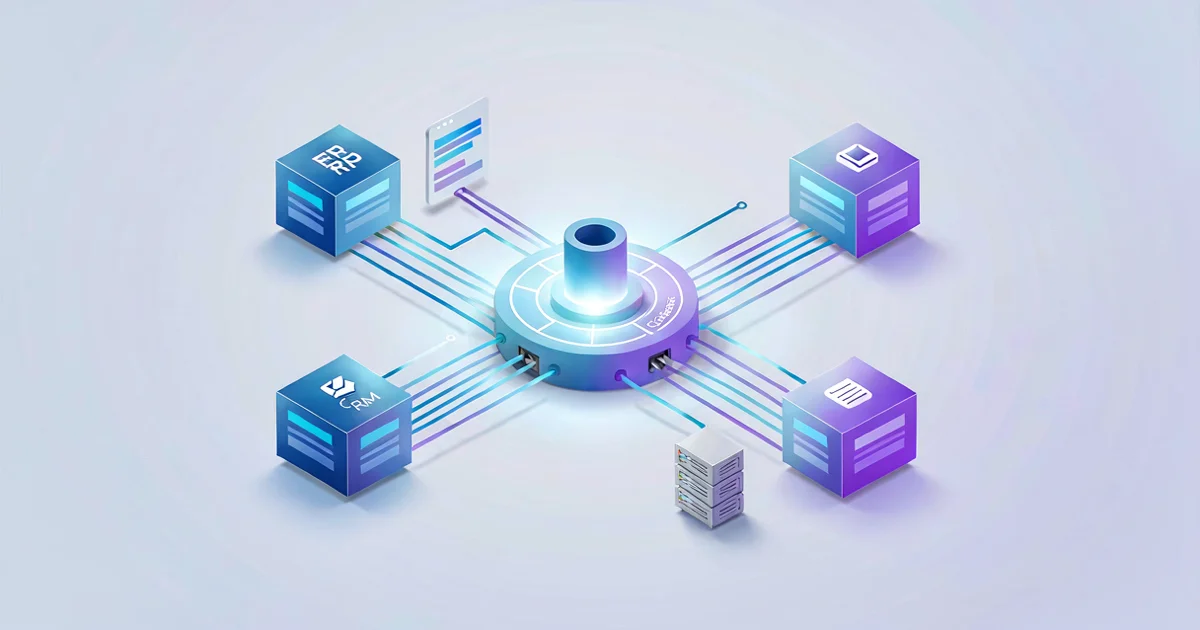
This is the shift worth knowing about. The Model Context Protocol, or MCP, is an open standard for how AI models connect to tools and data sources. The simplest way to think about it: MCP is doing for AI-to-system connections what USB did for hardware. Before USB, every device needed its own special port and cable. After USB, there was one standard plug and everything just worked.
MCP plays the same role. Instead of writing a custom integration for every model-to-system pairing, you expose each system once through a standard interface, and any MCP-capable AI can use it. Connect your ERP, your CRM, and your internal database via MCP, and an AI assistant can query inventory, look up a customer, and check an order — through one consistent mechanism rather than three bespoke ones. As the standard gains adoption across the major AI platforms, it is rapidly becoming the default way to give AI real, governed access to a business’s systems.
The practical payoff is huge: connections become reusable instead of disposable, new AI capabilities can be added far faster, and you are far less locked into any single vendor. Building these MCP connections to your knowledge and tools is increasingly central to how we approach AI integrations.
What this unlocks once it is in place
Connection is the enabler; the value shows up in what becomes possible afterwards.
- AI that answers from live data. “What’s our stock on SKU 4471 and when’s the next delivery?” answered instantly from the actual ERP, not a stale export.
- End-to-end automation. A workflow that reads an order, checks inventory, updates the CRM, and triggers fulfilment — across systems, without a human shuttling data between them. This is where connection meets process automation and the real time savings appear.
- Agents that act, not just answer. As covered in our piece on AI agents, an agent is only as capable as the systems it can reach. MCP is increasingly how it reaches them safely.
- A foundation that compounds. Every system you connect makes the next AI capability cheaper to add, because the plumbing is already there.
Doing it safely
Giving AI access to your core systems is powerful, which means it has to be done with discipline. A few principles that matter:
- Least privilege. Each connection should expose only the data and actions genuinely needed — read-only where writing is not required, scoped to the relevant records.
- Clear boundaries on actions. Reading data is low-risk; changing it is not. High-stakes actions should require approval or be ruled out entirely.
- Auditability. Every access and action should be logged, so you can see exactly what the AI did and why — essential both for debugging and for compliance under regulations like the EU AI Act.
- Built, not bolted on. Security designed into the integration from the start is far cheaper and far stronger than security added after something goes wrong.
The bottom line
The companies getting real value from AI are not the ones with secret access to better models. They are the ones that did the connection work — that gave their AI real, governed, real-time access to the systems where their business actually runs. APIs made that possible; MCP is making it dramatically easier and more durable.
If your AI efforts have felt underwhelming, the model is probably not the problem. The connection is. And that is an entirely solvable engineering problem.
Want your AI to actually work inside your business, not just talk about it? Get in touch and we will map how to connect your ERP and tools — safely and built to last.
Sound like a problem in your business?
We connect tools and automate workflows for SMEs every week — a free discovery call and a fixed written quote, no obligation.
Get a free proposal