Everyone has met the old chatbot. The one that offered five buttons, none of which matched your problem, before finally admitting it would “connect you to an agent.” It trained a whole generation of customers to type “human” the moment a chat window opened.
The technology that replaced it shares a name and almost nothing else. Modern AI assistants — grounded in your real knowledge and able to act in your systems — resolve problems instead of deflecting them. The shift from chatbot to agent is one of the highest-return AI projects most businesses can take on right now. Here is what actually changed, and how to do it well.
Why the old chatbots failed
Old chatbots were decision trees in disguise. A human mapped out every conversation path in advance, and the bot could only follow the script. The moment a customer phrased something unexpectedly — which is to say, almost always — the tree collapsed. They could not understand nuance, could not access live data, and could not do anything. They were a worse FAQ page with a personality.
The first wave of large language models fixed the language problem: suddenly the bot could understand almost anything a customer typed. But it introduced a new one. A raw model answers from its training data, which means it confidently invents details about your business — your return policy, your pricing, your hours — that it has no way of actually knowing. For customer operations, confident wrongness is worse than a dead end.
RAG: grounding the AI in your truth
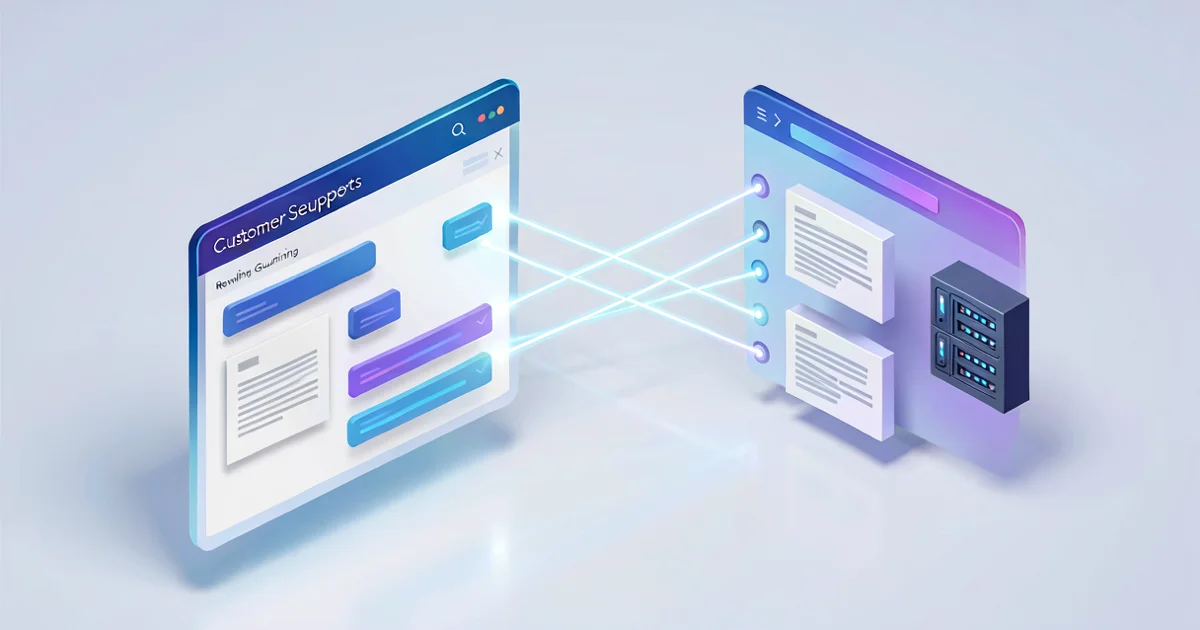
The technique that solves this is Retrieval-Augmented Generation, or RAG. The idea is simple and powerful. Instead of asking the model to answer from memory, you first retrieve the relevant information from your own trusted sources — help docs, policies, product data, past tickets — and hand it to the model along with the question. The model then answers from that material rather than from its imagination.
The effect is transformative. The assistant now speaks with your actual return policy in front of it. When you update a doc, the answer updates. When it does not know something, it can say so, because it can see that the retrieved material does not cover the question. RAG is what turns a clever-sounding model into a trustworthy one for your specific business.
Building a good RAG system is more involved than it sounds — the quality depends on how documents are chunked, indexed, retrieved, and kept current. Getting that pipeline right is the core of what we do in AI integrations: connecting a model to your knowledge so its answers are grounded, not guessed.
From answering to acting
Grounded answers are a huge step, but the real leap is when the assistant stops only telling customers things and starts doing things for them. “Where is my order?” should not return instructions on how to check — it should return the actual tracking status, pulled live from your systems. “I want to change my delivery address” should change the address.
This is where a chatbot becomes an agent. It needs secure, governed access to your backend — order system, CRM, billing — with clear boundaries on what it is allowed to do automatically and what requires escalation. Issuing a small refund for a clearly valid reason: fine, do it. A €2,000 dispute: gather the context and hand it to a person. Designing those action boundaries, and wiring the assistant safely into the systems that fulfil them, is a process automation problem as much as an AI one.
What this does to your support economics
The numbers are what make this compelling to a business, not the technology. A well-built grounded, action-capable assistant typically resolves a large share of routine contacts end-to-end, instantly, around the clock — the order statuses, password resets, policy questions, simple changes that make up the bulk of most support volume.
That does three things at once. Customers get instant resolution instead of queue time. Your human team stops drowning in repetitive tickets and gets to spend their attention on the complex, high-value, genuinely human conversations where they actually help. And your support cost stops scaling linearly with your growth. The goal is not to remove people — it is to stop wasting them on work a machine should handle, which is the whole philosophy behind our AI automation work.
How to do it without the classic mistakes
The failure modes here are well known, so they are avoidable:
- Start with your knowledge, not your bot. If your help docs are out of date, RAG will faithfully serve out-of-date answers. Cleaning and structuring the source material is the unglamorous first step that determines everything.
- Be honest that it is AI. Beyond being a transparency requirement under regulations like the EU AI Act, customers respond far better to a capable assistant that is upfront than to one pretending to be human and failing.
- Design the escalation path first. The fastest way to destroy trust is an agent that traps a frustrated customer in a loop. A clean, context-rich handoff to a human is a feature, not an admission of defeat.
- Measure resolution, not deflection. “Conversations handled without a human” is a vanity metric if those customers just gave up. Track whether the problem was actually solved.
- Roll out in stages. Start with read-only answering, prove it is accurate, then enable low-risk actions, then expand.
The bottom line
The gap between the chatbot people hated and the assistant people are happy to use is not subtle, and it is not far off — it is a project most businesses can complete in a matter of weeks once the knowledge and systems are in order. The companies doing it are quietly removing the single most common source of customer frustration while cutting cost. The ones still running 2019-era decision trees are training their customers to dread contacting them.
Want to turn your support from a cost centre into something customers actually like? Get in touch and we will scope what a grounded, action-capable assistant would look like for your business.
Sound like a problem in your business?
We build production AI — assistants, agents and automation grounded in your data. Free discovery call, fixed written quote, no obligation.
Get a free proposal